

Yoko Style
One to One is a magnificent rock concert documentary. It’s also a Yoko Ono fashion show.

Recently, I attended the New York City premiere of One to One. The documentary - which is co-directed by Kevin Macdonald and Sam Rice-Edwards - portrays John Lennon and Yoko Ono’s collaborative work as artists and activists in early seventies New York. As they generate headlines by protesting government corruption, racism, and war - with the help of Jerry Rubin and Allen Ginsberg - they ultimately staged the One to One benefit concert at Madison Square Garden in August 1972 to improve Willowbrook State School.
The Staten Island institution for mentally disabled children came to national attention after Lennon and Ono’s friend, the investigative journalist, Geraldo Rivera, fronted a televised exposé portraying its abusive, squalid and overcrowded conditions. When I wasn’t balling my eyes out watching highlights of Rivera’s heart-wrenching report - or marveling that he was a few seats away in the audience - I was admiring Ono’s fearless style.
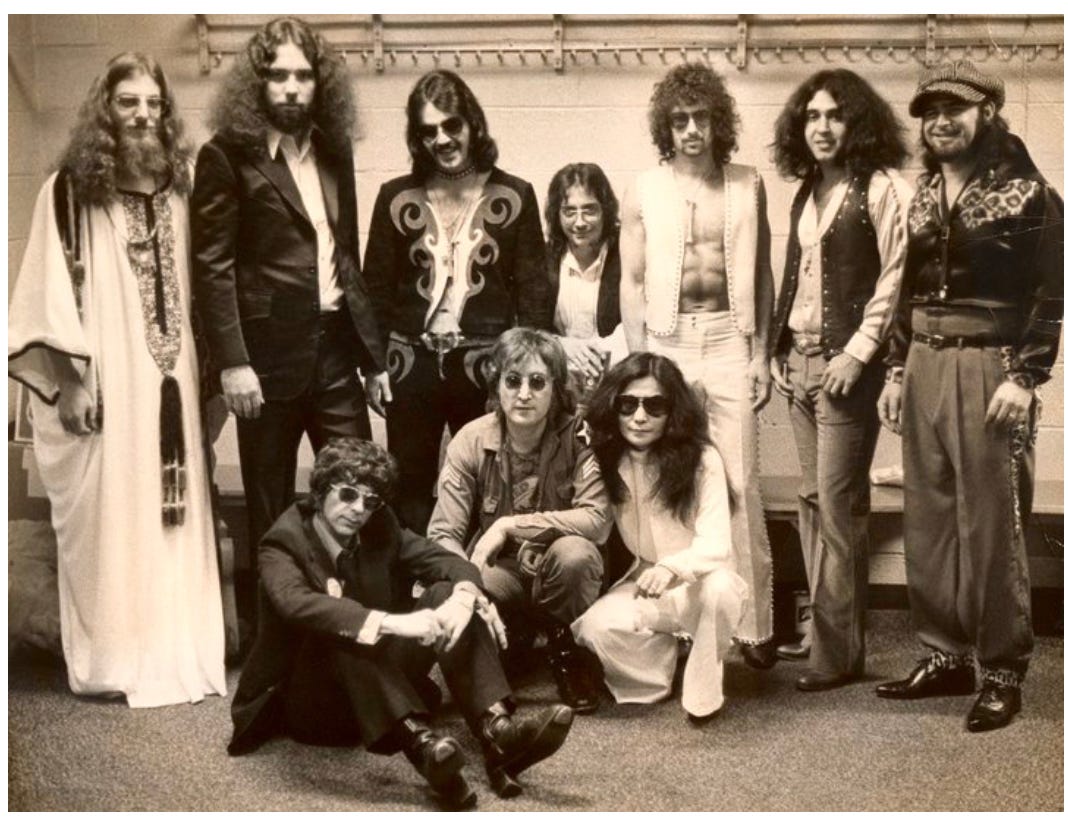
As the concert - which raised $1.5 million - swings into action, Ono, Lennon and their backup band, Elephant’s Memory (below), make their way from the arena’s green room to the stage. They are surrounded by hippies and suits yet bathed in stardust. Lennon gives a performance of his all-too-brief lifetime. Ono - who was on keyboards and vocals - more than holds her own.
With her black hair flowing, and signature dark sunglasses shielding her eyes from the stage lights - and pot fumes - she commands the spotlight in a white three-piece. Composed of a sporty zip-up jacket atop a mock turtleneck and flares, the look brought to my mind contemporary Courrèges. The jacket is off as she belts out “Don’t Worry Kyoko.”
The “feedback composition” was inspired by Ono’s custody fight with her ex-husband, Anthony Cox over their daughter, Kyoko. As Ono screeched and wailed, I surrendered to the experimental music yet I was initially as baffled as the audience who watched her inaugural performance of the “mournful caterwaul of despair….” at a Toronto benefit in 1969.
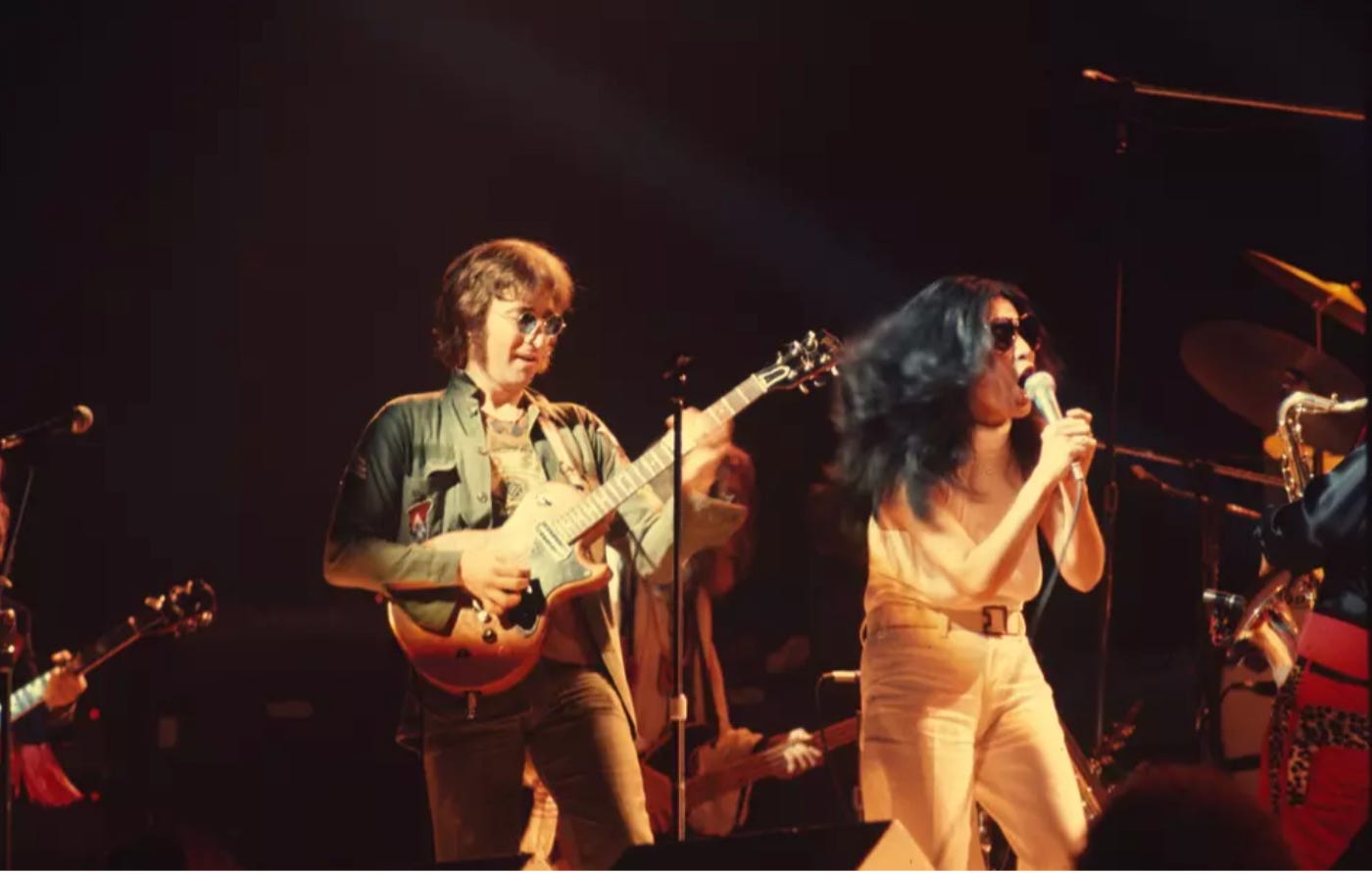
Through the film, Lennon wears faded denim, army fatigues and his signature granny glasses. His wardrobe suggests the agony and exhaustion he suffered during the protracted process of the Beatles’ breakup, which was finalized in 1974. By contrast, Ono’s gradual refinement signifies how she progressively moved out of her husband’s shadow.
David Sheff’s recently published Yoko: The Biography (Simon & Schuster) illuminates how Ono harnessed her artistic talent and personal flair to assert herself as a cultural figure against great odds and as the target of constant ethnic abuse. Noting Dick Cavett’s on-air statement that by the early seventies, Ono was “one of the most controversial ladies since the Duchess of Windsor…” Sheff adds that the journalist Ray Connolly “updated” the talk show host’s “Buckingham Palace reference” explaining: ‘Meghan Markle’s treatment when she got together with Prince Harry was nothing compared to the hatred directed at Yoko when she got together with John.’”
One to One showcases plenty of the “his & hers” outfits which they famously wore, after marrying in coordinating white separates in 1969. Ted Lapidus probably produced their wedding attire. The couple were spotted at the designer’s Left Bank boutique during their Paris honeymoon. Lennon - who frequently collaborated with Lapidus and flaunted one of his suits on Abbey Road’s album cover - “offered to finance a string of Lapidus boutiques in England,” according to WWD.
Like Ono, the “poet of haute couture” was passionately devoted to writing verse. After he taught fashion at a Tokyo college, his ready-to-wear became popular in Japan. He “made headlines when he introduced jeans into his couture lineup,” in 1968. But who knows if the stylish denim trousers in which Ono struts her stuff all through One to One were by Lapidus.
Fiercely protective of her own image - and Lennon’s - she maintained a sense of mystery about her sartorial preferences. For instance, during an interview with Vogue’s Eve McSweeney in 2006 she hinted that Lapidus had produced her bridal finery, yet failed to give the trailblazer his due, stating she “bought” the clothes “from a French designer who was famous for a while in the sixties and then disappeared.”
Ono’s regal demeanor and edgy glamour was definitely influenced by her “impeccably dressed” mother, Isoko Yasuda Ono. A descendant of the Yasuda banking dynasty - who were “among the four most influential and wealthiest families in Japan from the late 1800s through World War II…” - Isoko was cold and remote with her daughter. She left her upbringing to nannies and servants. “There are photographs of Isoko wearing long slinky dresses from Paris, strands of pearls and red lipstick,” Sheff writes.
“Micro shorts” - a hallmark of festival dressing, thanks to Kate Moss and Alexa Chung - were introduced to the rock scene by Ono and Keith Richards' girlfriend, Anita Pallenberg. In One to One, Ono wears a pair with a black blouse and choker. On a trip with Lennon to Niagara Falls she polishes the look with more black: sheer tights, knee-high boots and a flattering jacket. “This is the new feminist uniform,” she explained when in “tight black lamé” shorts she brushed shoulders with Uptown socialites Nan Kempner and Pat Buckley at a 1973 Peter Max happening.
A decade before Jackie Kennedy Onassis became famous for her sophisticated street style as she roamed Upper Manhattan, Lennon and Ono stopped traffic as they window shopped on Fifth Avenue and spent huge sums at Bergdorf Goodman, Bonwit Teller, Henri Bendel and swanky boutiques like De Noyer.
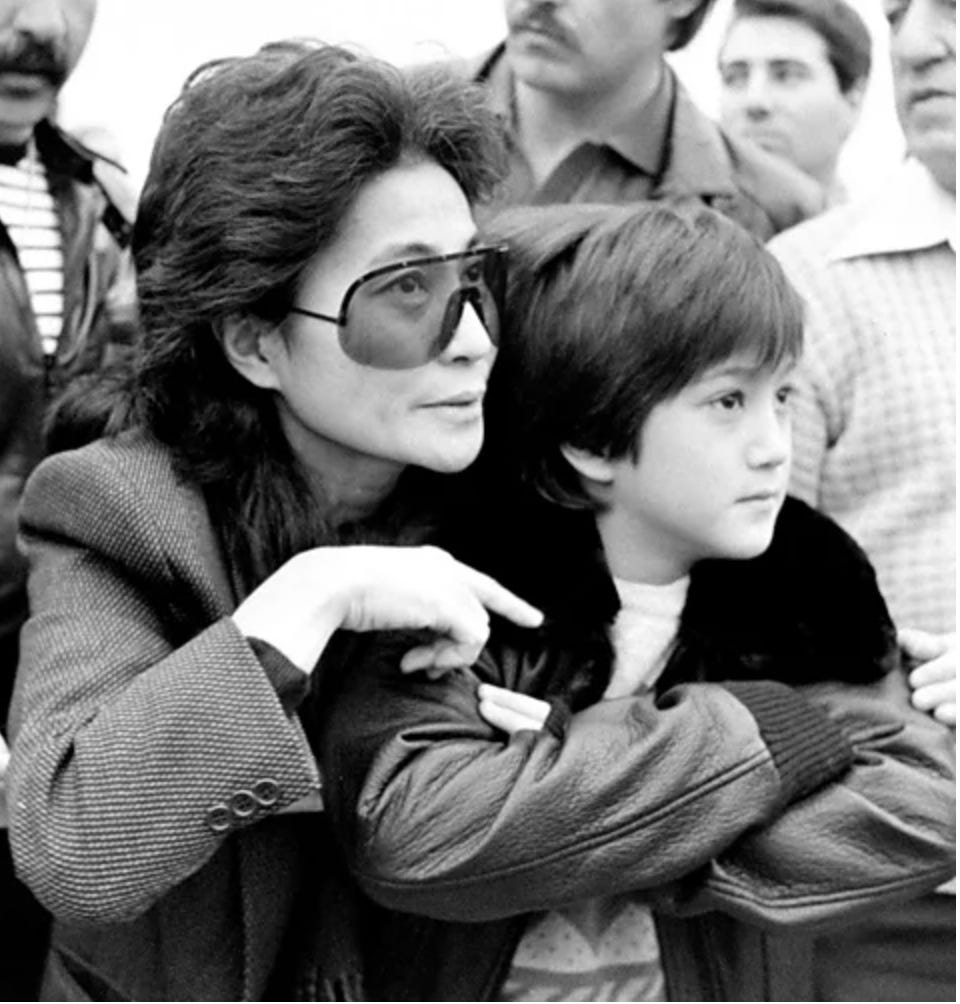
Near the end of One to One, Ono and Lennon have traded their downtown loft for the Dakota Apartments complex on Central Park West. Sheff recounts how a single apartment - among the six the couple gradually acquired there - “served mainly as a wardrobe closet” and also how Elton John - Sean Lennon’s godfather who was known for his own “insane” “shopping sprees…” - sent the couple a “teasing card with revised lyrics to the song ‘Imagine’:
Imagine six apartments
It isn’t hard to do
One is full of fur coats
Another’s full of shoes…”
Today, at 92, Ono lives on a farm in Upstate New York, where, according to her family, her time is devoted “listening to the wind and watching the sky,” not to mention taking a much deserved break from leading her life in the public eye. My guess is that she’s still wearing micro shorts.
This is so interesting! So well written. You are truly a fashion historian. You know so much!!
Great piece, Bronwyn. Can't wait to see the film.